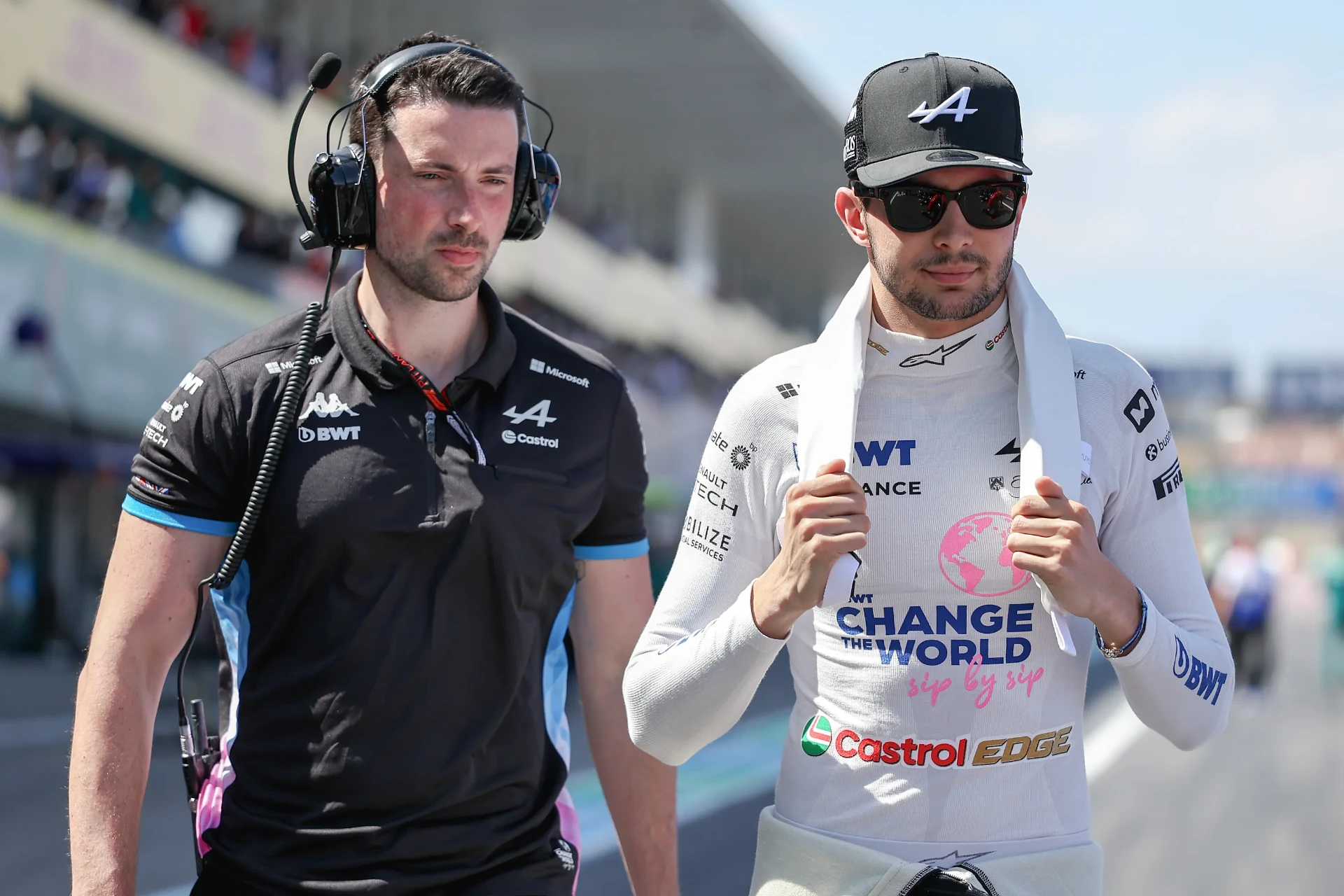
In Formula 1, sunglasses can look like style.
On Esteban Ocon, they may be something more useful: a small piece of performance equipment.
That matters, because in a sport obsessed with the visible margins — aero gains, tyre windows, brake temperatures, reaction times — some of the biggest advantages are invisible. Sleep. Circadian timing. Fatigue. The exact hour bright light hits your eyes. The exact hour it doesn’t.
Publicly, there is no solid evidence that Ocon wears sunglasses for a medical reason. But there is strong evidence that his environment has been engineered around controlling light exposure. Tom Clark, the performance coach who has worked closely with Ocon, has been unusually explicit about the role of light in managing jet lag. He has said that when he is trying to move an athlete’s body clock, he starts with light exposure before anything else. Reporting around Ocon’s routine has also referenced light-blocking sunglasses as one of the strategies Clark uses, alongside obsessive control of the sleep environment itself.
That changes the meaning of the sunglasses.
They stop being a celebrity accessory and start looking like a portable blackout curtain.
Travel fatigue versus jet lag
Because jet lag is not just tiredness. It is mistimed biology.
The key distinction, and one Clark emphasizes in his work, is the difference between travel fatigue and jet lag. Travel fatigue is the wear and tear of the journey: sitting for hours, dehydration, cramped movement, cabin air, disrupted meals, stress, poor sleep opportunity. Jet lag is something else. It is the internal clock being out of sync with the external clock. One is the cost of travel. The other is a scheduling error inside the body. The literature on athletes makes exactly this distinction and argues that both problems need different countermeasures.
That is why the sunglasses matter.
Light is the strongest lever
The human circadian system does not care what your boarding pass says. It responds to timing cues, especially light. Reviews on jet lag and circadian adaptation consistently identify light exposure and light avoidance as the most powerful non-pharmacological tools for shifting the body clock. Bright light at the right time can push the clock earlier or later; bright light at the wrong time can do the opposite. The timing is everything.
This is the scientific backbone behind Clark’s approach with Ocon. In interviews, Clark has described light as the main differentiator in how much jet lag an athlete will or will not get. He has explained that the work starts before the flight, shifting sleep and exposure patterns so the athlete is already closer to destination time before takeoff. He has also made clear that he prefers light-based shifting first, with melatonin used more selectively rather than as the default solution.
That approach lines up well with the research.
A major review on minimizing jet lag argues that eastward and westward travel should be handled differently, because advancing the clock is usually harder than delaying it. It recommends carefully timed light exposure and, when used, carefully timed melatonin relative to the body’s core temperature minimum rather than vague “take it at bedtime” advice. Another review aimed at athletes reaches a similar conclusion: manipulate the time-givers, especially light, because careless exposure can be counterproductive.

The other half of Clark's playbook is deliberately getting bright light at the right time — and these are the portable way to do it. Blue-enriched light-therapy glasses you can wear on a plane or in a hotel to nudge your body clock toward destination time. Timed exposure is the evidenced lever; melatonin stays the selective add-on.
Why flying east hits harder
The body clock, after all, is not a simple 24-hour stopwatch. It runs a little longer than 24 hours on average, which is one reason delaying the clock can be easier than advancing it. That is also why eastward travel tends to feel worse. When you fly east, you are asking biology to go to bed earlier than it wants. When you fly west, you are usually asking it to stay up later, which humans often tolerate better. Reviews and athlete studies repeatedly show that eastward travel is commonly the more difficult adjustment, though some field data suggest that long-haul westward trips can also create meaningful recovery costs depending on the sport and competitive schedule.
What jet lag costs an F1 driver
This is where elite sport gets ruthless.
For most travelers, jet lag means feeling bad in a meeting.
For an F1 driver, it can mean degraded reaction time, poorer decision-making, worse mood, reduced training quality, inferior recovery, and missed learning consolidation after a race weekend. Clark has pointed out that sleep is not just about feeling rested; it supports memory consolidation and physical recovery, both critical in a sport where drivers and engineers are constantly trying to absorb information and refine performance from one session to the next. Reporting on Ocon’s routine underscores how tightly this is managed, down to room temperature, light leakage, and sleep tracking.
What the sunglasses actually do
That makes the paddock sunglasses easier to read.
They are not the whole system. They are the public-facing tip of it.
A pair of dark lenses can reduce unwanted light at the wrong circadian moment, especially when an athlete is trying to avoid a phase shift in the wrong direction. In practical terms, that might mean protecting a planned sleep window after arrival, reducing exposure during a sensitive pre-sleep period, or simply making sure airport terminals, hotel lobbies, media pens and device-heavy environments do not undo the schedule. The research is clear that wrong-time light can delay or advance the clock in unwanted ways. Even if sunglasses are a blunt tool compared with a full protocol, they fit the logic of circadian control.

The object at the centre of the story. Dark, high-coverage shades are the portable way to cut unwanted light in terminals, lobbies and media pens — exactly the wrong-time exposure Clark engineers around. The Vulcans give you full UV cover and a filter-category-3 lens in a British-made frame light enough to actually keep on. Sunglasses as performance equipment, not accessory.
The stronger claim would be that Ocon wears sunglasses specifically for jet lag every time he wears them. That cannot be proved from the public record. The safer claim is better: Ocon works inside a performance system where light exposure is treated as a lever, and light-blocking eyewear has been reported as one of the tools in that system.
And that is the bridge to the bigger story.
From the paddock to a product: Phaze
Because Tom Clark did not leave this insight inside Formula 1.
He productized it.
Clark is now the founder of Phaze, a platform built around the same basic premise that shows up in his work with Ocon: travel should not be managed reactively, and sleep/travel schedules should not be generic. On its official site, Phaze says it helps coaches and consultants personalize sleep and travel schedules using circadian science so athletes, team members and support staff are ready to perform wherever they are. The site describes a two-part system: an app for athletes and staff, and a coaching hub for practitioners and performance directors. Coaches upload travel schedules and key performance times; athletes then receive a personalized plan that guides light exposure, sleep, training and recovery; coaches can track sleep, circadian alignment and performance data in real time.

Phaze App (by Tom Clark)
The App Store listing pushes the same story in more consumer-friendly language. It describes Phaze as “Your Travel Performance Coach,” says it is “rooted in science and inspired by Formula 1,” and highlights personalized schedules, jet lag management, an integrated light scanner, performance planning around key events, and cross-time-zone support. Apple’s listing also shows the app under Phaze Shift Ltd and indicates version history beginning in 2025, which suggests the product has moved from concept into active release and iteration.
That is the real significance here.
Clark is not selling a motivational slogan about sleep.
He is turning a specialist workflow into software.
For years, coaches have handled this work manually: spreadsheets, phone notes, messaging chains, rule-of-thumb sleep advice, a rough understanding that east is harder than west, and a lot of seat-of-the-pants decision-making once the team lands. Phaze is trying to formalize that process. It takes the logic used in elite performance environments — define the destination demands, estimate the body-clock gap, prescribe the right timing of light, sleep, activity and recovery — and puts it into a system that can scale across more people than one coach can manage alone.
That timing is not accidental.
Elite sport is traveling more, not less. Competition calendars are denser. Support staff are under similar strain to athletes. Recovery windows are shorter. The Phaze site leans into exactly that pain point, arguing that elite teams are traveling more while recovering less, and that sleep and travel protocols remain too manual, too generic, or too reactive. The broader athlete literature backs that framing: travel fatigue and jet lag are persistent performance issues, but real-world management remains under-studied and often inconsistent in practice.
Why it starts with sunglasses
What makes the story work is that it starts with something visual and ordinary.
Sunglasses.
Everyone understands them. Everyone has seen drivers wearing them. But once you know what Clark is actually optimizing, the object changes meaning. The sunglasses are a clue that in high performance, fatigue is not always fought with more effort. Sometimes it is fought with less light.
That is a much sharper story than “jet lag sucks.”
Jet lag does suck. But for athletes, it is also measurable, manipulable, and — to a surprising degree — schedulable.
That is the bet behind Clark’s work with Ocon. And now it is the bet behind Phaze: that the same circadian science once used quietly inside one driver’s travel routine can become a usable system for coaches, consultants, teams and performance staff at scale.
